Hard water leaves scale on your fixtures, cuts your water heater's lifespan, and makes soap and shampoo work twice as hard. Picking the right water softener means matching grain capacity, resin type, and valve style to your household's actual water usage and hardness level, not just buying whatever's cheapest at the big box store.
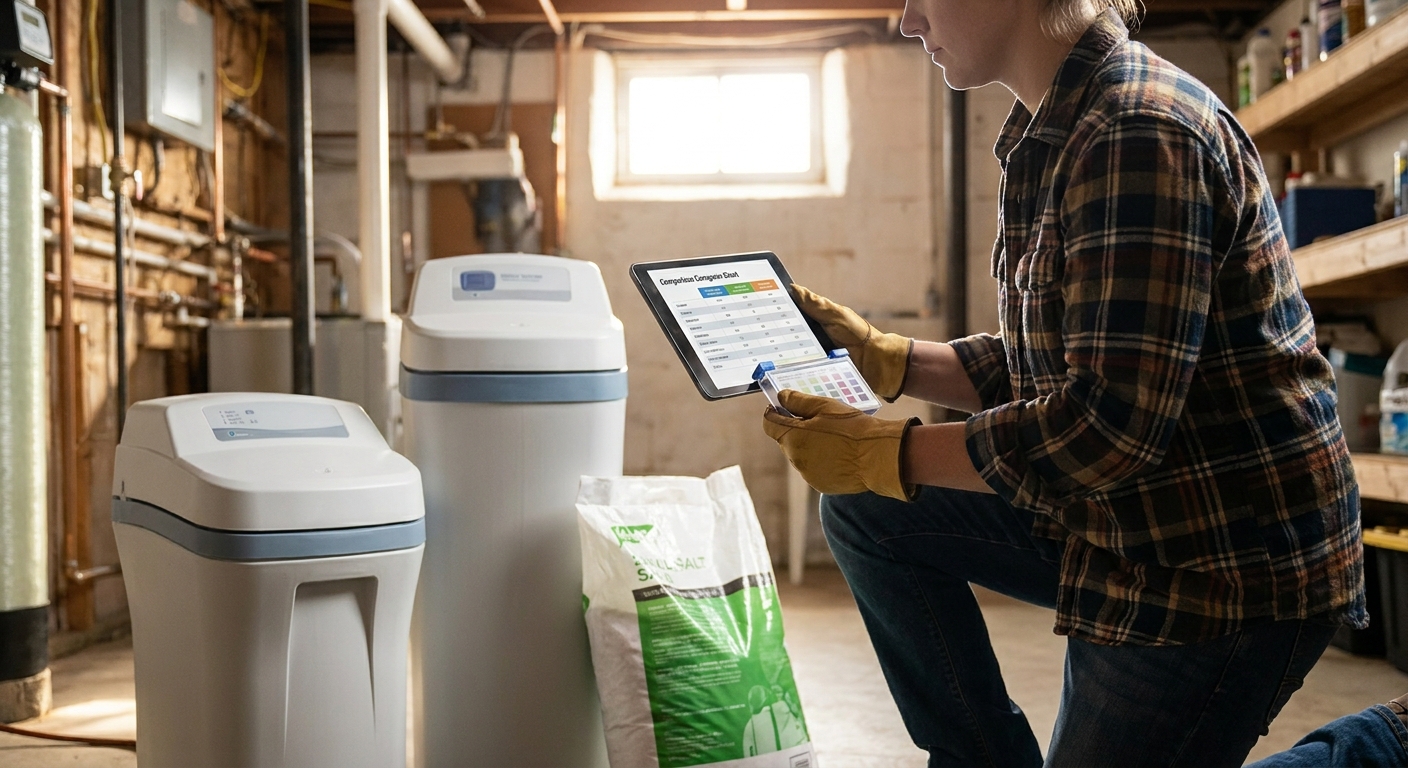
- Test your water hardness in grains per gallon (GPG) before shopping - most hard water homes fall between 7 and 15 GPG.
- Size the softener to your household's daily gallon use times hardness, not just bedroom count. Buy: a correctly sized salt-based softener for whole-house hard water in 2026.
- Dual-tank systems give continuous soft water; single-tank systems regenerate on a schedule and can leave you with hard water during recharge.
- Skip salt-free conditioners if your GPG reads above 10 - they don't remove hardness minerals, they just alter crystal structure.
- A licensed plumber should verify your main line size and drain access before installation to avoid pressure loss.
Why this matters
Hardness minerals - mostly calcium and magnesium - build up inside pipes, water heaters, and fixtures over years. A tankless water heater running on water above 10 GPG can lose efficiency within 12 to 18 months as scale coats the heat exchanger. Homeowners in older Sacramento-area houses with galvanized or original copper lines feel this fastest: reduced flow, chalky fixtures, and shortened appliance life.
Choosing the wrong unit - undersized capacity, wrong resin type, poor valve quality - means you're either paying for salt and water you don't need or living with hard water anyway because the softener can't keep up. Getting the sizing and type right the first time saves you a second install within a few years.
What you'll need
- A water hardness test result in grains per gallon (GPG) - test strips or a lab report from your water provider
- Your household's average daily water use in gallons (check a recent water bill or estimate 80-100 gallons per person per day)
- Access to your main water line and a nearby drain for the softener's discharge
- Basic plumbing tools if you're prepping the space: pipe wrench, tubing cutter, Teflon tape
- A licensed plumber for the actual tie-in, especially on homes with older galvanized supply lines
- Rock salt or potassium chloride pellets for ongoing operation
If water heater filtration systems or fixture upgrades are already on your list, a plumbing contractor that handles both water softener installation and water heater work in the same visit saves you a second service call.
The steps
1. Test your water hardness in GPG
Buy a hardness test kit or request a water quality report from your utility. Anything above 7 GPG is classified as hard; above 10 GPG is very hard. This number drives every sizing decision that follows - guessing here leads to an undersized system that never keeps up. Expect a result between 1 and 25 GPG depending on your source; most municipal Sacramento-area supplies land in the moderately-to-very-hard range.
Common mistake: relying on a neighbor's number instead of testing your own tap. Hardness varies by well, by municipal zone, and by season.
2. Calculate your daily softening demand
Multiply your household's daily gallon use by your GPG reading. A four-person home using 320 gallons a day at 12 GPG needs a system rated for 3,840 grains of removal capacity per day. This single number is what separates a softener that lasts and one that runs out of capacity by dinnertime.
Common mistake: sizing off bedroom count instead of actual usage. A two-bedroom home with a hot tub and a large family uses far more water than the 2-bedroom rule of thumb assumes.
3. Choose grain capacity with a buffer
Match your daily demand to a softener rated for 7 to 10 days of capacity between regenerations, not exactly one day's worth. For the 3,840-grain daily example above, look at systems rated 30,000 to 40,000 grains. Running a unit at the bare minimum forces daily regeneration cycles, which burns through salt fast and shortens resin life.
Common mistake: buying the smallest unit that technically covers daily demand, then discovering it regenerates every single night.
4. Pick single-tank vs. dual-tank
Single-tank softeners regenerate on a timer or meter and leave you with unsoftened water for an hour or two during that cycle - fine for most households. Dual-tank systems swap tanks automatically so one is always in service, which matters for larger families or homes that never want a hard-water gap. Dual-tank units cost more upfront but eliminate the regeneration blackout window entirely.
Common mistake: installing a dual-tank system in a small household where the extra capacity and cost never gets used.
5. Decide between salt-based and salt-free
Salt-based ion-exchange softeners actually remove calcium and magnesium from the water - this is the only method that reduces GPG readings. Salt-free conditioners alter mineral crystal structure so it doesn't stick to pipes as easily, but they don't lower hardness and generally underperform above 10 GPG. If your test came back above 10 GPG, salt-based is the correct call for 2026 installs.
Common mistake: choosing salt-free to avoid sodium in drinking water, then wondering why scale buildup continues on very hard water.
6. Check valve quality and control head
The control valve is the component that fails first on cheap units - look for a metered (demand-initiated) valve rather than a basic timer, since metered valves regenerate based on actual water use instead of a fixed clock, saving salt and water. Brass or noryl valve bodies outlast plastic ones under Sacramento's mineral-heavy water.
Common mistake: focusing entirely on tank size and ignoring the valve, which is the part most likely to need service within the first 5 years.
7. Confirm installation requirements before buying
Verify you have a nearby drain for backwash discharge, adequate electrical outlet access, and enough clearance for salt refills. Homes with 3/4-inch main lines may see pressure drop with an oversized unit; a licensed plumber can confirm your line size handles the softener's flow rate before you commit to a model.
Common mistake: buying online without measuring the installation space, then finding the unit doesn't fit the utility closet or garage corner where it needs to go.
Troubleshooting
- Water still feels hard after installation - check that the bypass valve is fully open in service position; a valve left in bypass mode routes water around the softener entirely.
- Softener runs out of salt too fast - your grain capacity is likely undersized for actual usage; recalculate demand using a full week of water bills, not an estimate.
- Salty taste in drinking water - the brine tank may be overfilled or the resin bed needs a deep clean; potassium chloride pellets reduce sodium taste if this persists.
- Low water pressure after install - confirm the unit's flow rate rating matches your home's peak demand; an undersized valve or clogged resin bed both cause this.
- Softener regenerates in the middle of the night constantly - the meter may be misreading usage or the capacity is too small for the household; a metered valve should regenerate every 3-7 days under normal use, not daily.
- Scale still forming on fixtures months later - resin beads degrade over 10-15 years or foul from iron in the water; a resin cleaner or bed replacement usually fixes this.
Get your water softener sized right
A plumber-verified GPG test and sizing check before you buy anything.
Tools and resources
- Water hardness test strips or a lab water quality report
- Recent water bills to calculate average daily gallon use
- Tape measure for utility closet or garage clearance
- Pipe wrench, tubing cutter, and Teflon tape if prepping the line yourself
- A licensed residential plumbing contractor for the main-line tie-in and drain connection
What to do next
Once you've got a GPG reading and a daily-demand number, the sizing decision in step 3 becomes straightforward math rather than guesswork. Homeowners tackling a whole-house repipe or new water heater install at the same time should coordinate both jobs together in 2026 - running new supply lines is the easiest moment to also add a softener loop before drywall goes back up.
FAQ
What's the best water softener for hard water homes?
A metered salt-based ion-exchange softener sized to your household's daily gallon use times its GPG reading is the best fit for most hard water homes. Salt-free conditioners work for mild hardness under 10 GPG but don't actually remove minerals from very hard water.
How do I know if my water is hard enough to need a softener?
Water testing above 7 grains per gallon (GPG) qualifies as hard, and above 10 GPG is considered very hard. A test strip kit or a water quality report from your utility gives you this number directly.
How much does a water softener cost to install in 2026?
Costs vary by grain capacity, valve quality, and installation complexity, so get a site-specific quote rather than relying on a national average. Older homes with galvanized lines often need extra plumbing work that adds to the install.
Is dual-tank better than single-tank for a water softener?
Dual-tank systems keep soft water flowing continuously because one tank regenerates while the other stays in service, which matters for larger households. Single-tank units are cheaper and fine for homes that can tolerate a short regeneration window, usually overnight.
Can a water softener fix low water pressure caused by scale buildup?
A softener prevents new scale from forming but doesn't remove scale already built up inside old pipes. Homes with significant existing buildup may need a repipe alongside the softener to fully restore pressure.
How often does a water softener need salt?
Most households refill the brine tank every 4 to 6 weeks, depending on grain capacity and daily water use. Running out of salt lets hard water pass through untreated, so check the tank monthly.
Do I need a plumber to install a water softener?
A licensed plumber should handle the main-line tie-in and drain connection, especially in homes with older galvanized supply lines where pressure and fitting compatibility matter. DIY installs on newer copper or PEX lines are more common but still risk voiding warranties if done incorrectly.
What GPG level requires a water softener instead of a filter?
Any reading above 7 GPG benefits from a softener, since standard filters remove sediment and chlorine but don't address dissolved calcium and magnesium. Above 10 GPG, a salt-based softener is the only method that reliably drops hardness.
One last thing
The single biggest sizing mistake homeowners make isn't picking the wrong brand - it's calculating demand off bedroom count instead of a real water bill. Pull three months of actual gallon usage before you shop in 2026, and the grain-capacity decision practically makes itself.