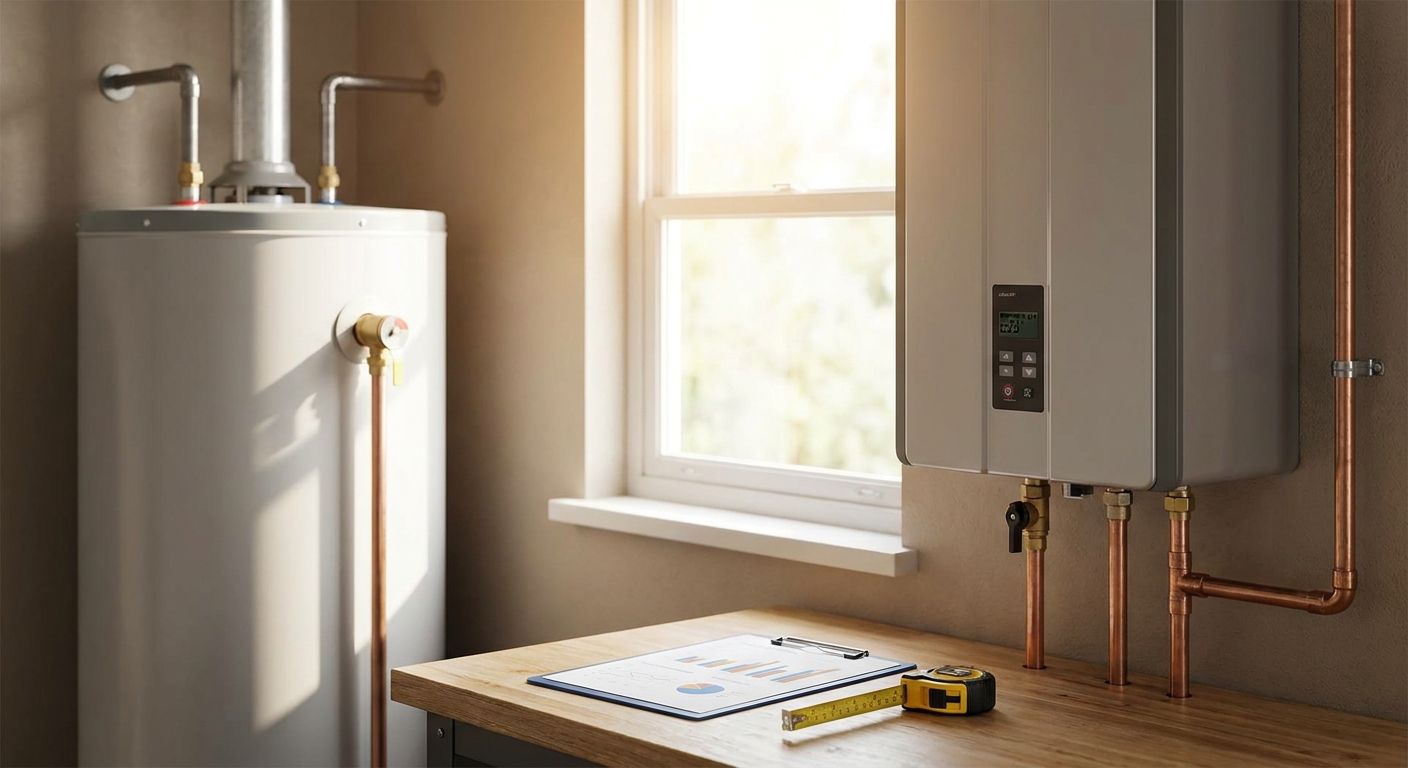
Choosing between a tankless and a traditional tank water heater in 2026 comes down to three numbers: how many gallons of hot water your household actually uses at peak times, how much space and gas or electrical capacity you have, and how many years you plan to stay in the house. Get those three right and the rest of the decision solves itself.
- Tankless water heaters cost $3,000-$5,500 installed in 2026 and last 20+ years; tank units run $1,200-$3,000 and last 10-15 years.
- In the tankless vs traditional water heater decision, households using under 41 gallons a day see the biggest efficiency gains.
- Flores Precision Plumbing recommends tankless for Sacramento homes with 3+ bathrooms or simultaneous hot water demand.
- Traditional tanks win on upfront cost and simpler repairs for smaller households, condos, and rentals.
- Sacramento's hard water shortens the life of both types if you skip a softener or annual flush.
Why This Matters
A water heater is one of the few appliances that runs every single day and fails without much warning. Pick the wrong type for your household size and you either overpay for capacity you never use or run cold showers during a Sunday morning rush.
Sacramento adds a wrinkle most national buying guides skip: hard water. Mineral buildup accelerates tank corrosion and clogs tankless heat exchangers faster than in cities with softer municipal supply, which changes the math on which unit actually lasts its rated lifespan. Flores Precision Plumbing sees both failure patterns regularly in Sacramento-area homes, and the fix is almost always tied to water hardness, not the brand of heater installed.
What You'll Need
- Peak demand estimate — number of bathrooms, showerheads, and appliances (dishwasher, washing machine) that might run hot water at once
- Gas line size or electrical panel capacity — tankless units need higher gas flow or a dedicated 240V circuit depending on fuel type
- Installation space measurements — tankless units mount on a wall and need roughly 2 square feet; tanks need floor space for a 40-60 gallon cylinder
- Water hardness reading — grains per gallon, from a test strip or your last water quality report
- Budget range — $1,200-$3,000 for tank, $3,000-$5,500 for tankless installed in 2026
- Permit awareness — Sacramento County requires a permit for water heater replacement, tankless or tank
The Steps
1. Calculate your household's peak hot water demand
Count every fixture that could run hot water at the same time on a busy morning: two showers, a dishwasher, a washing machine. This accomplishes one thing — it tells you the flow rate in gallons per minute (GPM) you actually need, which is the single biggest factor in sizing either system correctly. A household running two showers simultaneously needs roughly 5 GPM of hot water; most single tankless units deliver 6-10 GPM depending on model and incoming water temperature. Common mistake: sizing off bathroom count alone instead of simultaneous-use scenarios, which leads to a tankless unit that runs cold water mid-shower.
2. Check your existing gas line and electrical capacity
Tankless units, especially gas models, need a larger gas line than most older Sacramento homes have running to the water heater closet — often 3/4-inch versus the 1/2-inch line feeding a standard tank. This matters because undersized gas supply causes error codes and reduced output, not unit failure, so swapping the heater alone won't fix it. Have a plumber measure the existing line and calculate BTU demand for the specific tankless model before ordering it. Expected outcome: a clear yes/no on whether gas line upsizing adds to your installed cost. Common mistake: assuming a straight swap because "it's the same water heater closet."
3. Measure your installation space
Tank heaters need floor space and vertical clearance for a 40-60 gallon cylinder; tankless units mount on a wall and free up that floor space entirely. This step matters most for homes converting a water heater closet into storage or laundry space during a remodel. Measure wall area near the gas or electrical connection point — tankless units need roughly 20 inches by 28 inches of clear wall. Expected outcome: confirmation the new unit fits without relocating gas lines or vents. Common mistake: forgetting venting clearance requirements for gas tankless models, which need dedicated intake and exhaust runs.
4. Compare upfront cost against 15-20 year total cost of ownership
A tank heater installed for $1,200-$3,000 will likely need replacement once, sometimes twice, in the time a single tankless unit lasts. This step matters because sticker price alone hides the real comparison — tankless units rated for 20+ years often work out cheaper per year of service than two tank replacements over the same span. Run the math: divide installed cost by expected lifespan years for each option, then add estimated energy savings. Expected outcome: a per-year cost figure you can compare directly. Common mistake: comparing only the purchase price and ignoring energy savings or replacement frequency.
5. Factor in Sacramento's hard water
Hard water deposits scale inside tank heaters and clogs the narrow heat exchanger passages in tankless units faster than soft water does, cutting into the lifespan numbers used in step four. This matters because a tankless unit rated for 20 years in ideal conditions can lose several years of service life without a softener or annual descaling flush. Check your water hardness reading and factor in either a whole-house softener or a yearly maintenance flush cost of roughly $150-$250 for tankless units. If hard water is a factor in your neighborhood, the water softener buying guide covers sizing one for your home before or alongside a heater swap. Expected outcome: a maintenance line item added to your total cost comparison. Common mistake: skipping softener consideration and blaming the water heater brand when scale buildup causes early failure.
6. Check rebates and permit requirements
Sacramento County and utility providers periodically offer rebates for high-efficiency water heaters, and either heater type requires a permit for replacement. This step matters because skipping the permit creates problems at resale — unpermitted water heater work shows up in home inspections. Confirm current rebate programs with your utility provider and pull the permit before, not after, installation. Expected outcome: any available rebate applied to your final cost, and a paper trail for future resale. Common mistake: assuming no permit is needed for a like-for-like swap — Sacramento requires one regardless.
7. Get a load-matched quote, not a swap quote
A quote based on simply matching your old unit's size ignores the demand calculation from step one. This matters because undersized tankless installs are the most common complaint homeowners have after switching. Ask any plumber quoting the job to show the GPM calculation and gas line assessment in writing, not just a unit price. Expected outcome: a quote tied to your actual household demand, not a generic swap. Common mistake: accepting a flat tank-to-tankless conversion price without a demand calculation behind it.
8. Schedule installation and set a maintenance schedule
Once the unit is sized and the quote confirmed, schedule installation and set a recurring reminder for maintenance — annual flush for tankless, or a check on the anode rod and sediment for tank units. This matters because both types fail early primarily from neglect, not manufacturing defects. Expected outcome: a working system and a maintenance date on the calendar for 2027. Common mistake: treating a water heater as a set-it-and-forget-it appliance, especially in a hard water market like Sacramento.
Get a load-matched quote today
Flores Precision Plumbing sizes tankless and tank installs to your actual demand, not a swap.
Troubleshooting
- Water turns cold when two showers run at once. The tankless unit is undersized for simultaneous demand — recheck the GPM calculation from step one; a second unit or a larger model may be the fix.
- Tank heater runs out of hot water faster than it used to. Sediment has built up on the tank floor from hard water, reducing usable capacity — schedule a tank flush before assuming the unit is failing.
- Tankless unit throws an error code during startup. Usually a gas supply or venting restriction, not a unit defect — recheck gas line sizing and vent length against manufacturer specs.
- Utility bill went up after switching to tankless. Often an oversized unit cycling inefficiently, or a vent run longer than rated — get the install re-checked against manufacturer BTU and vent-length limits.
- Rusty water from a tank heater. The anode rod has depleted and the tank is corroding from the inside — this is typically a sign the unit is near end of life, not a fixable component issue.
- Tankless unit takes longer to deliver hot water than the old tank did. Normal for units installed farther from fixtures — a recirculation pump shortens wait time if this becomes a daily annoyance.
Tools and Resources
- Water hardness test strips or your utility's latest water quality report
- A tape measure for installation space and wall clearance
- Manufacturer BTU and gas line sizing charts for the specific tankless model under consideration
- The water softener buying guide if hard water is a factor in your decision
- Sacramento County permit office for replacement permit requirements
What to Do Next
If your household uses less than 41 gallons of hot water daily and you have the gas or electrical capacity, tankless is the stronger long-term buy in 2026 — verdict: Buy tankless for demand-matched, multi-bathroom Sacramento homes. If you're in a smaller household, a rental, or a home with limited gas line capacity, a properly maintained tank heater remains the practical, lower-upfront-cost choice — verdict: Buy traditional tank for budget-sensitive or lower-demand households. Either way, check your water hardness before finalizing the decision, since scale buildup is what actually cuts both systems short of their rated lifespan.
FAQ
Is a tankless water heater worth it in 2026?
Tankless is worth it for households using less than 41 gallons of hot water daily and homes with 3 or more bathrooms, where the 20+ year lifespan offsets the higher $3,000-$5,500 installed cost. Smaller households or short-term homeowners often break even faster with a traditional tank.
How much does it cost to switch from a tank to a tankless water heater?
Switching typically costs $3,000-$5,500 installed in 2026, which can include gas line upsizing and venting changes not needed for a like-for-like tank swap. Get a load-matched quote that itemizes gas line work separately from unit cost.
Do tankless water heaters work with hard water?
Tankless units work with hard water but scale builds up in the heat exchanger faster than in a tank, shortening service life without a softener or annual flush. In Sacramento, pairing a tankless unit with a whole-house softener protects the manufacturer's rated lifespan.
What size tankless water heater do I need for a 3-bathroom house?
Most 3-bathroom households need a unit rated for 8-10 GPM to cover two simultaneous showers plus a dishwasher or washing machine cycle. Undersizing is the most common cause of cold-water complaints after installation.
How long do traditional tank water heaters last?
Traditional tank water heaters last 10-15 years on average, shorter in hard water areas without regular sediment flushing. Anode rod depletion and tank corrosion are the two most common end-of-life signs.
Can I install a tankless water heater in the same space as my old tank?
Tankless units mount on a wall and need about 20 by 28 inches of clear space plus dedicated venting clearance, which usually frees up the floor space a tank occupied. Venting and gas line routing, not floor space, are the actual constraints to check first.
Do tankless water heaters need a bigger gas line?
Most gas tankless units need a larger gas line than a standard tank, often 3/4-inch versus 1/2-inch, because of higher BTU demand during operation. Confirm this with a BTU calculation before quoting the job, not after installation.
Is a traditional tank water heater cheaper to repair?
Yes, tank heater repairs like anode rod replacement or thermostat swaps typically cost less than tankless heat exchanger or control board repairs. Tank components are simpler and more widely stocked by plumbers.
One Last Thing
Most tankless installation complaints trace back to gas line sizing decided before the unit was even chosen, not to the equipment itself — get the demand calculation and gas line check done first, and the unit selection becomes the easy part of the tankless vs traditional water heater decision.