Building a new home in Sacramento means the water heater gets picked once, buried in a wall or garage corner, and forgotten for the next 10-15 years. Get the sizing, fuel type, and code details wrong at rough-in and you're paying to rip out drywall later.
- Water heater installation new construction should match fixture count, not square footage — a 4-bath home needs 8+ GPM tankless or a 75-gallon tank.
- Title 24 seismic strapping and expansion tanks are non-negotiable on every new build permit in Sacramento in 2026.
- Tankless gas units rated 9-10 GPM are the safe pick for 3+ bathroom homes; standard 50-gallon tanks are the budget pick for 1-2 bath homes.
- Skipping a recirculation line at rough-in costs more to retrofit than to install upfront during framing.
Why this matters
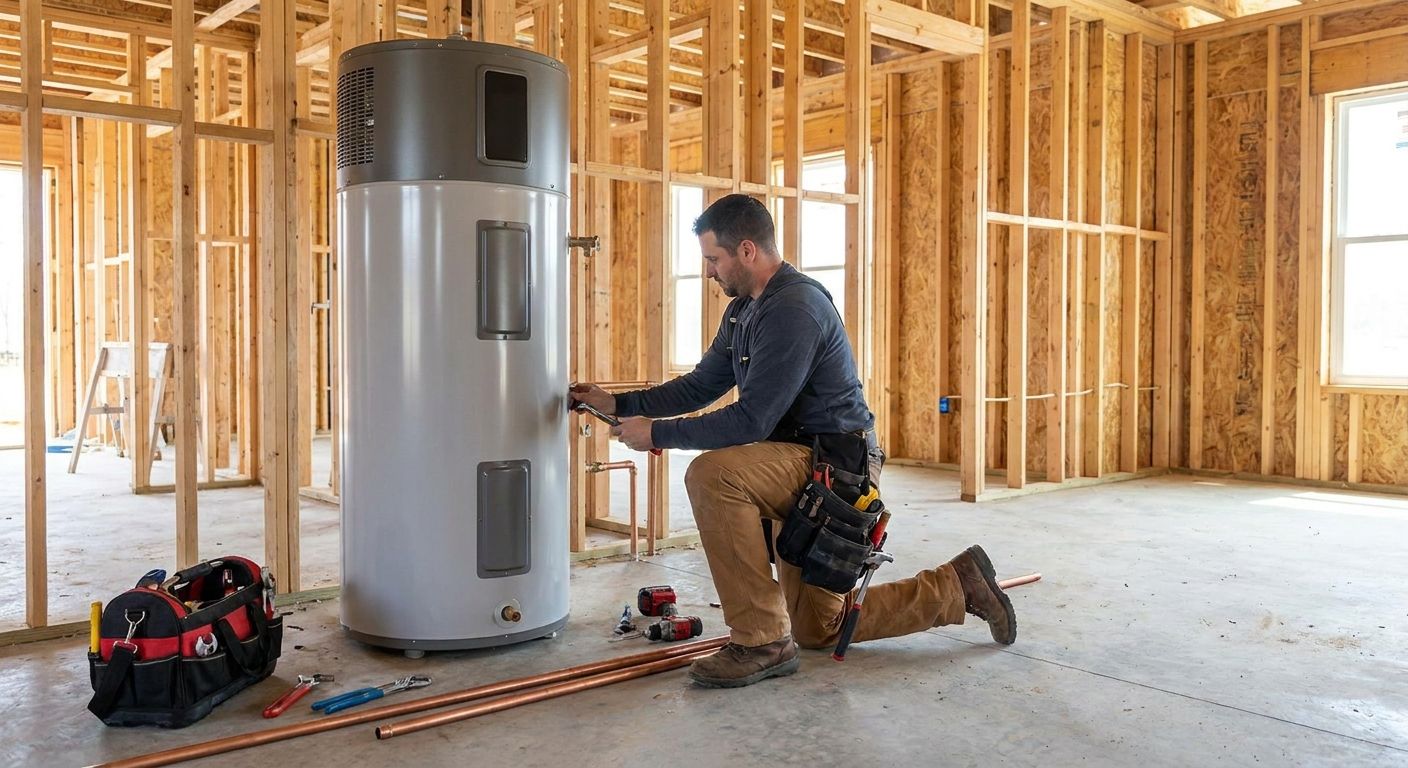
A water heater installed during new construction is a one-time decision baked into the plumbing rough-in — the gas line size, the vent path, the electrical circuit, and the drain pan location all get locked in before drywall goes up. Change your mind after the walls close and you're paying for demo, not just a new unit. Sacramento's 2026 building code also requires seismic strapping, a thermal expansion tank on closed systems, and a temperature-pressure relief valve routed to an approved discharge point — miss any of those at inspection and the job stalls.
Who this is for
This guide is for homeowners building a new house or doing a full remodel in the Sacramento area who need to choose and install a water heater as part of the plumbing rough-in — not homeowners replacing a failed unit in an existing house. If you're working with a general contractor or framing crew right now, the decisions below need to happen before the plumber sets rough-in, not after.
Homes with 3+ bathrooms, in-law units, or dedicated laundry rooms need different sizing math than a 2-bed starter home, and getting that wrong at framing means a call-back after move-in. Flores Precision Plumbing handles water heater installation for new residential construction and whole-house repipe projects across Sacramento, and the sizing conversation happens before the first pipe goes in the wall.
What to look for in a water heater for new construction
Sized to fixture count, not square footage
Sizing by bedroom count is the most common mistake on new builds. A 4-bathroom home with two showers running simultaneously needs a unit rated for 8-10 gallons per minute (GPM) if going tankless, or a 75-gallon tank if going conventional — a 40-gallon tank will run cold on the second shower every time.
Fuel type matches what's already stubbed
Gas lines and electrical panels get sized during rough framing, and switching fuel type after that point means re-running a gas line or upgrading a panel. Confirm gas line diameter (3/4-inch minimum for a tankless unit) or electrical capacity (30-40 amp dedicated circuit for hybrid heat pump models) before the unit gets ordered.
Title 24 and seismic compliance
California's Title 24 energy code sets minimum Uniform Energy Factor (UEF) ratings for new installs, and every water heater in a new build needs seismic strapping at two points plus a code-compliant expansion tank on a closed system. Skip the expansion tank and the pressure relief valve will weep constantly — that's a callback waiting to happen.
Vent path and clearance
Gas tankless units need a dedicated vent run, usually PVC or stainless, with a maximum length set by the manufacturer — running it too far or through too many elbows drops efficiency and can trip an error code. Confirm the vent path during framing, not after drywall is up.
Recovery rate for household demand
Recovery rate (how fast a tank reheats) matters more than tank size for households that run laundry and showers back to back. A 50-gallon tank with a 40,000 BTU burner recovers around 40 gallons per hour — fine for two people, tight for a family of five doing morning showers.
Recirculation readiness
If the primary bathroom sits more than 40 feet of pipe run from the water heater, hot water can take 60-90 seconds to arrive. Running a dedicated recirculation loop at rough-in costs a fraction of what it costs to retrofit through finished walls later.
Planning a new build water heater install
Get sizing and code requirements confirmed before rough-in starts.
Top picks by home type
The high-volume pick — gas tankless, 9-10 GPM. Best for homes with 3+ bathrooms and simultaneous fixture use. A 10 GPM unit supports two showers and a dishwasher running at once without a temperature drop, and it takes up a fraction of the wall space a tank does. Upfront equipment and install cost runs higher than a tank, but there's no standby heat loss and no tank to fail from sediment over time. Verdict: Buy for homes with 3+ full bathrooms.
The budget-safe pick — 50-gallon gas tank, 40,000 BTU. Best for 1-2 bathroom homes and rental units where upfront cost matters more than peak-demand performance. Recovery rate around 40 gallons per hour covers a typical morning routine for a couple or small family without runouts. Verdict: Buy for starter homes and secondary units.
The efficiency pick — hybrid heat pump, 50-gallon. Best for all-electric new builds chasing the lowest Title 24 energy score. UEF ratings on hybrid units commonly land above 3.0 versus roughly 0.6-0.7 for standard electric resistance tanks, cutting water heating energy use substantially over a year. It needs a dedicated 30-40 amp circuit and a space that stays above roughly 40°F year-round, which rules out unconditioned garages in colder Sacramento winters. Verdict: Consider for all-electric builds with a conditioned mechanical room.
The wildcard — 75-gallon high-recovery gas tank. Best for large households (5+ people) that want tank simplicity without the tankless price tag. A high-recovery burner rated near 65,000 BTU can recover close to 65 gallons per hour, closing most of the gap with tankless performance at a lower equipment cost. It's a bigger footprint — plan for it during framing, not after. Verdict: Buy for large households wanting tank reliability.
Skip pick — undersized 30-40 gallon electric tank in a 3+ bath home. It looks like the cheapest line item on the build budget, but it runs out of hot water on day one and gets replaced within two years. Verdict: Skip for anything beyond a 1-bathroom accessory unit.
What to avoid
- Sizing off the builder's default spec sheet. Production builders often spec the smallest code-legal tank to hit a price point — confirm actual fixture count and simultaneous-use scenarios before signing off.
- Skipping the expansion tank to save $150-200. Every closed-loop system in Sacramento new construction needs one under 2026 code, and skipping it shows up as a failed inspection or a leaking relief valve within months.
- Choosing hybrid heat pump for an unconditioned garage. These units lose efficiency and can underperform below about 40°F, which happens on cold Sacramento mornings in an unheated garage.
Verdict comparison
| Type | Best for | Key number | Verdict |
|---|---|---|---|
| Gas tankless, 9-10 GPM | 3+ bathroom homes | 9-10 GPM continuous | Buy |
| Standard 50-gal gas tank | 1-2 bathroom homes | ~40 gal/hr recovery | Buy |
| Hybrid heat pump, 50-gal | All-electric builds | UEF 3.0+ | Consider |
| High-recovery 75-gal tank | 5+ person households | ~65 gal/hr recovery | Buy |
| Undersized 30-40 gal electric | Nothing beyond 1-bath ADU | Runs out in 2 years | Skip |
Sacramento's water also runs hard — often in the 150-200 ppm range — which shortens tank life on any of these picks if there's no softener ahead of the unit. The guide to choosing a water softener for hard water homes covers sizing a softener to pair with a new water heater install.
FAQ
How much does water heater installation for new construction cost in 2026?
Water heater installation for new construction runs from roughly $1,800 for a standard 50-gallon gas tank up to $4,500+ for a gas tankless system with venting, based on 2026 regional labor and equipment pricing. Cost depends on fuel type, venting complexity, and whether a recirculation line is added at rough-in.
Is tankless better than a tank for a new build?
Tankless wins for homes with 3+ bathrooms and simultaneous fixture use because it delivers continuous hot water at 9-10 GPM without a tank to store or reheat. A standard tank is the better call for 1-2 bathroom homes where upfront cost matters more than peak capacity.
Do I need a permit for water heater installation in new construction?
Yes — new construction water heater installs are covered under the overall plumbing permit and must pass inspection for seismic strapping, expansion tank, and TPR valve discharge routing before drywall goes up. Skipping this step means an inspector can red-tag the rough-in.
What size water heater do I need for a 4-bedroom house?
A 4-bedroom, 3-bathroom house typically needs a 75-gallon tank or a tankless unit rated 9-10 GPM to cover simultaneous showers and laundry. Bedroom count matters less than bathroom count and fixture layout for accurate sizing.
Can I install a hybrid heat pump water heater in a garage?
Only if the garage stays above roughly 40-50°F year-round, since hybrid units lose efficiency in cold ambient air. An unconditioned Sacramento garage in winter is a poor fit unless it's insulated and semi-conditioned.
How long does water heater installation take during new construction?
Rough-in for the water heater typically takes half a day during framing, with the final unit set and connected in another half day closer to project completion in 2026 builds. Total timeline depends on inspection scheduling more than labor time.
Should I add a recirculation line during new construction?
Yes, if any bathroom sits more than 40 feet of pipe run from the water heater, since retrofitting a recirculation loop after walls are finished costs several times more than running it at rough-in. It's one of the cheapest upgrades to add before drywall.
Does hard water affect a new water heater's lifespan?
Yes — Sacramento water hardness in the 150-200 ppm range accelerates sediment buildup in tank-style heaters and can shorten lifespan by several years without a water softener ahead of it. Tankless units are also affected, since scale buildup on heat exchangers reduces flow and triggers error codes.
One last thing
The detail most new-construction plans miss isn't the unit itself — it's the discharge point for the temperature-pressure relief valve. Code requires it to terminate at an approved location outside living space, and on more than one Sacramento new build the framing crew boxes in that exact spot before the plumber ever sees the plan. Confirm that discharge path on the drawings before framing closes it off, not during the final inspection.