Sizing a tankless water heater comes down to matching your home's peak hot-water demand, in gallons per minute, to a unit that can still deliver that flow at your winter incoming water temperature — not picking a model because it's the biggest one on the shelf.
- Sizing a tankless water heater starts with total simultaneous GPM demand, not square footage or your old tank's gallon rating.
- Sacramento winter groundwater runs in the mid-50s°F, so most homes need a unit rated for at least a 45-50°F temperature rise to hit 105°F output.
- A shower plus a running dishwasher can pull 4-5 GPM combined — undersized units cause the classic cold-water-sandwich complaint.
- Four-bathroom homes and larger families often need two units piped in parallel instead of one oversized single unit.
- A unit's GPM rating drops as temperature rise increases, so the number printed at a 35°F rise isn't what you get on a cold January morning.
Why this matters
An undersized tankless water heater is the single most common complaint homeowners bring to a tankless water heater installation for Sacramento homeowners job in 2026 — not the unit failing, just water going lukewarm the moment a second fixture turns on. Tank water heaters forgive bad sizing because they store 40-50 gallons of buffer. Tankless units don't store anything; they heat water on demand, so the unit has to keep up with real-time flow or the output temperature drops immediately. Get the GPM and temperature-rise math right once, and the sizing question is solved for the life of the unit.
What you'll need
- A list of every hot-water fixture in the house (showers, tubs, kitchen and bathroom faucets, dishwasher, washing machine)
- The flow rate (GPM) for each fixture — check the fixture spec plate or use standard code figures
- Your incoming groundwater temperature (Sacramento averages in the mid-50s°F in winter)
- Your target output temperature (105°F is standard for showers and most household use)
- A manufacturer spec sheet or performance chart for the unit(s) you're considering
- 30-45 minutes to run the math before you call anyone for a quote
If you're still deciding whether tankless is the right call at all, read how to choose between tankless and traditional water heaters before you go further — sizing only matters once you've committed to the tankless route.
The steps
1. List every fixture that could run at once
This defines your worst-case demand, which is the number a tankless unit has to be sized against. Walk through a normal busy morning: someone showers while the dishwasher runs, or two bathrooms are in use back to back. Write down every fixture that realistically overlaps, not every fixture in the house. Common mistake: counting every fixture in the home as if they'll all run simultaneously — that inflates the sizing and pushes you toward a unit (or a second unit) you don't need.
2. Add up the flow rates to find your peak GPM
Standard flow rates: a shower runs around 2.5 GPM (the federal maximum), a kitchen faucet around 1.5-2.2 GPM, a bathroom faucet around 1.0-1.5 GPM, a dishwasher around 1-2.5 GPM, and a washing machine around 1.5-3 GPM. Add the fixtures from step one together. A shower plus a running dishwasher lands around 4-5 GPM combined — that's your target simultaneous flow rate. Expected outcome: a single number, in GPM, that represents your household's realistic peak demand.
3. Find your home's required temperature rise
Subtract your incoming water temperature from your target output temperature. In the Sacramento area, groundwater in winter runs in the mid-50s°F, and most households target a 105°F output for showers — that's roughly a 50°F rise. Summer incoming temps run warmer, so your rise requirement is lower half the year, but the unit still has to handle winter. Why it matters: every tankless unit's GPM rating changes depending on the rise it's asked to produce — more rise means less flow.
4. Match your GPM at your rise to a manufacturer spec sheet
Manufacturer spec sheets list GPM output at multiple rise levels, usually 35°F, 50°F, and 70°F. Find the GPM figure at the rise you calculated in step three, not the headline number on the box, which is usually the lowest-rise figure. If your peak demand is 5 GPM at a 50°F rise, the unit needs to hit 5 GPM at that specific rise, not at 35°F. Common mistake: buying based on the biggest GPM number printed on the packaging instead of the number at your actual rise.
5. Decide between one unit and a two-unit parallel system
Larger homes with four or more bathrooms, or households running multiple showers and a laundry cycle at once, often exceed what a single residential tankless unit can deliver at a 50°F rise. Two units piped in parallel split the load and give you redundancy if one needs service. If your peak GPM lands above roughly 8-9 GPM at your rise, price out a two-unit setup before you settle on one oversized single unit — best tankless water heaters for large families breaks down which models handle multi-bathroom households best. Expected outcome: a decision on unit count before you touch pricing.
6. Check your gas line and vent sizing
A correctly sized tankless unit still underperforms if the gas line feeding it is undersized — gas-fired tankless units draw significantly more BTU input than a standard tank water heater. Confirm the gas line diameter and length match the manufacturer's requirement for your model, and confirm venting is rated for the unit's exhaust category. Common mistake: sizing the water heater correctly and then discovering the existing gas line can't feed it at full output.
7. Confirm electric capacity if you're going electric
Electric tankless units size differently — they're limited by your home's electrical panel capacity, not gas line diameter. A whole-house electric tankless unit sized for a 50°F rise at 4-5 GPM typically needs a dedicated high-amperage circuit, sometimes more than one. Check your panel's available capacity before assuming electric tankless can replace a gas system. Why it matters: panel upgrades add real cost and time to a project that otherwise looks straightforward.
8. Get the load calculation confirmed before you buy
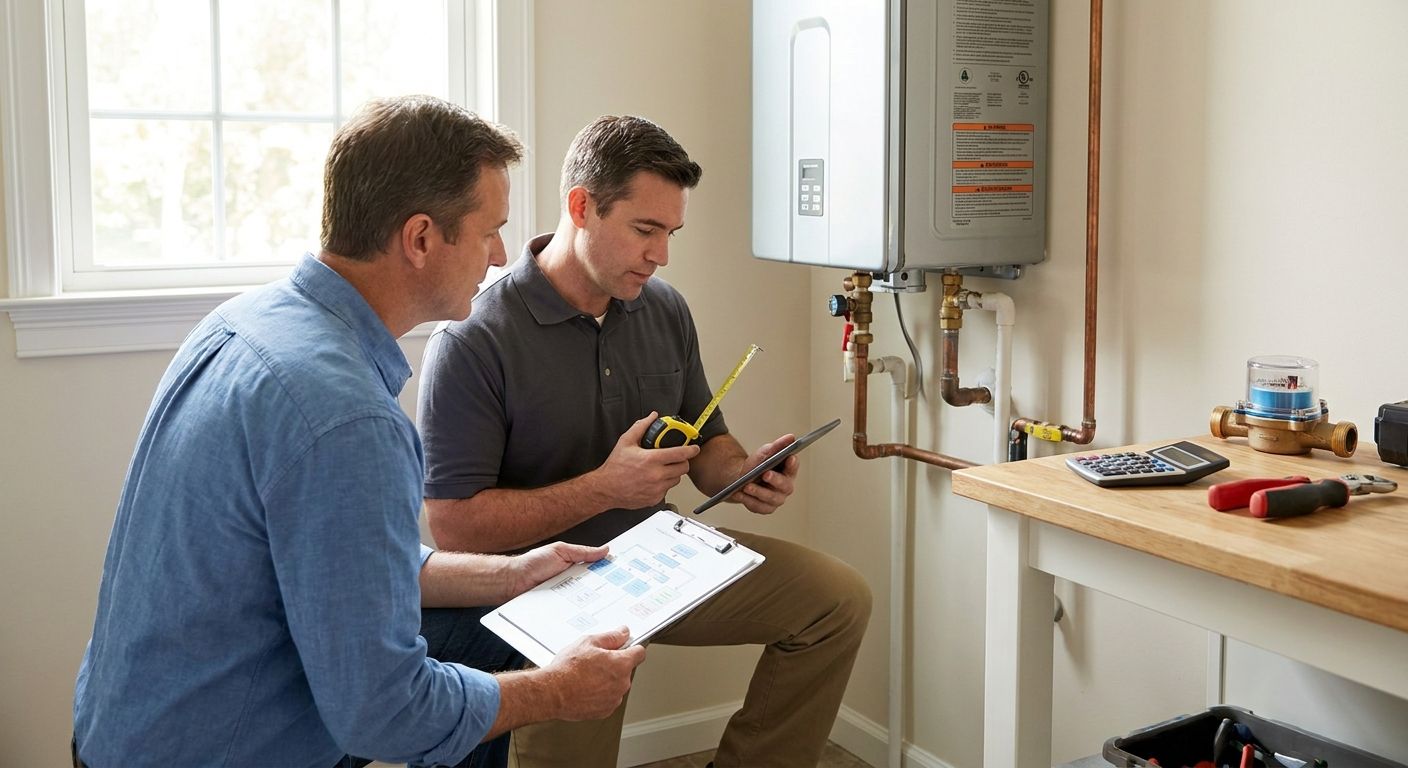
Run your numbers past whoever is doing the installation before you purchase a unit. A load calculation catches errors in fixture counts, temperature rise assumptions, or gas line capacity that are expensive to fix after a unit is mounted on the wall. Expected outcome: a confirmed unit size (or two-unit plan) with no surprises at install.
Get your home's exact GPM sizing
Flores Precision Plumbing runs the load calculation and quotes the right unit for your home.
Troubleshooting
- Water goes cold when a second shower turns on. The unit is undersized for your simultaneous GPM demand — recheck your fixture list against the unit's rated output at your actual temperature rise.
- Hot water takes a long time to arrive. This is usually pipe length or a cold-water sandwich effect, not a sizing problem — sizing controls flow capacity, not delivery time from the unit to the fixture.
- The unit short-cycles or won't fire at low flow. Small fixture combinations sometimes fall below the unit's minimum activation flow rate, usually around 0.5-0.75 GPM — running two low-flow fixtures together can trigger this.
- Performance drops noticeably in winter. Colder incoming groundwater increases your required temperature rise, which reduces the unit's max GPM output — this is expected behavior, not a defect, if the unit was sized for summer temperatures only.
- Output temperature has dropped over the past year or two. Mineral scale buildup on the heat exchanger reduces effective capacity over time, especially in hard water areas — a flush service restores most of the lost performance.
- The unit seems undersized even though the math checked out. Newer high-flow fixtures (rain shower heads, soaking tubs) installed after the original sizing can push actual demand above the original calculation — resize whenever fixtures change.
Tools and resources
- Manufacturer spec sheets showing GPM output at multiple temperature rises
- A running list of household fixtures and their flow rates
- Tankless water heater installation for Sacramento homeowners for a professional load calculation and install quote
- How to flush a tankless water heater to keep a correctly sized unit performing at rated capacity
- Flores Precision Plumbing's homepage for water heater, repipe, and fixture services across Sacramento
What to do next
Once sizing is confirmed, the decision that actually affects your monthly bill and comfort is tankless versus tank in the first place — if you haven't settled that, work through how to choose between tankless and traditional water heaters before finalizing a unit.
FAQ
What size tankless water heater do I need for a family of four?
Most four-person households need a unit rated for 5-7 GPM at a 50°F temperature rise, covering a shower plus a dishwasher or washing machine running at the same time. Larger homes with multiple bathrooms in use simultaneously may need a higher-capacity single unit or two units in parallel.
How do I calculate GPM for a tankless water heater?
Add up the flow rates of every fixture that could realistically run at the same time — a shower at roughly 2.5 GPM plus a dishwasher at 1-2.5 GPM, for example. That combined number is your target simultaneous flow rate at your required temperature rise.
Why does temperature rise matter when sizing a tankless water heater?
A unit's GPM output drops as the required temperature rise increases, so the flow rate printed at a low rise on the packaging isn't what you get in winter. Sacramento's mid-50s°F winter groundwater typically requires a 45-50°F rise to hit a 105°F output.
Is it better to install one large tankless unit or two smaller ones?
For homes with four or more bathrooms or peak demand above roughly 8-9 GPM at their required rise, two units piped in parallel usually outperform one oversized single unit and add redundancy if one needs service. Smaller homes with lower simultaneous demand do fine with a single correctly sized unit.
Can an undersized tankless water heater be fixed without replacing it?
Sometimes — reducing simultaneous fixture use, lowering the target output temperature slightly, or adding a second unit in parallel can resolve undersizing without a full replacement. If the gap between demand and capacity is large, replacement with a correctly sized unit is usually the more reliable fix.
Does hard water affect tankless water heater sizing?
Hard water doesn't change the initial sizing calculation, but mineral scale buildup on the heat exchanger reduces a unit's effective GPM output over time if it isn't flushed regularly. A unit sized correctly on day one can underperform within a couple of years without maintenance.
What's the difference between gas and electric tankless sizing?
Gas tankless units are limited by gas line diameter and BTU input capacity, while electric tankless units are limited by your home's electrical panel and available amperage. Whole-house electric tankless systems sized for a 50°F rise often require a panel upgrade that gas systems don't need.
How much does it cost to size and install a tankless water heater in 2026?
Installed cost depends on unit capacity, whether a gas line or panel upgrade is needed, and whether one or two units are required for the home's demand. Get a load calculation and site-specific quote before comparing prices, since sizing errors are the biggest cost driver after installation.
One last thing
The number that trips up more homeowners than any other in this process isn't GPM — it's temperature rise. Two identical households with the same fixture count can need different-sized units simply because one has colder incoming groundwater in winter, and Sacramento's mid-50s°F winter temps push nearly every household toward the 50°F-rise column on the spec sheet, not the lower-rise numbers printed in bold on the box.