Small households in Sacramento don't need an industrial-sized system, and most homeowners overpay for capacity they'll never use. This guide ranks the salt-free water softener options that actually fit a one-to-three-bathroom home in 2026, with clear buy calls for each.
- Aquios Full House Water Softener and Filter wins for small households on footprint alone — buy it if space is tight.
- SpringWell FutureSoft is the best salt free water softener for homes wanting stronger scale control without a bigger tank.
- Salt-based systems still outperform on true hardness removal — a salt-free conditioner only prevents scale buildup, it doesn't soften water technically.
- Skip any unit not NSF/ANSI 42 certified for scale reduction claims in 2026 — the certification is the only real verification standard.
- Installed cost for a compact salt-free system runs roughly $1,000 to $3,000 depending on home size and add-ons.
Why This Matters
Sacramento water runs hard enough that scale builds up inside pipes, water heaters, and fixtures faster than most homeowners expect. A salt-free water softener, technically a Template Assisted Crystallization (TAC) conditioner, doesn't remove calcium and magnesium the way a salt-based system does — it changes the mineral structure so it can't stick to surfaces.
That distinction matters for small households especially. You're paying for scale prevention, not water softness in the traditional sense, and picking the wrong unit means you get neither. Hard water left untreated also shortens the life of tank and tankless water heaters, which is worth reading up on separately in hard water effects on water heaters if you're dealing with premature heater wear.
Before buying anything, get a water hardness test. Homes under 10 grains per gallon (GPG) often do fine with a compact TAC unit; anything higher and a salt-free system may not keep up. If you're unsure which category your home falls into, the criteria in choosing a water softener for hard water homes walks through the hardness thresholds that decide the call.
How These Systems Were Ranked
This list weighs four things that matter most for a small household: physical footprint, flow rate relative to household size, whether the manufacturer holds NSF/ANSI 42 certification for scale reduction claims, and total installed cost. Systems built for four-bathroom homes with high-GPM demands get downgraded here even if they're well-reviewed elsewhere — a small household doesn't need that capacity and shouldn't pay for it.
Every unit named below is a commercially available salt-free conditioner or filter-softener combo as of 2026. None of this is based on lab testing — it's aggregated from published specs and certification data, so verify current model numbers and warranty terms directly with the manufacturer before buying.
The Ranked List
1. Aquios Full House Water Softener and Filter — the space saver
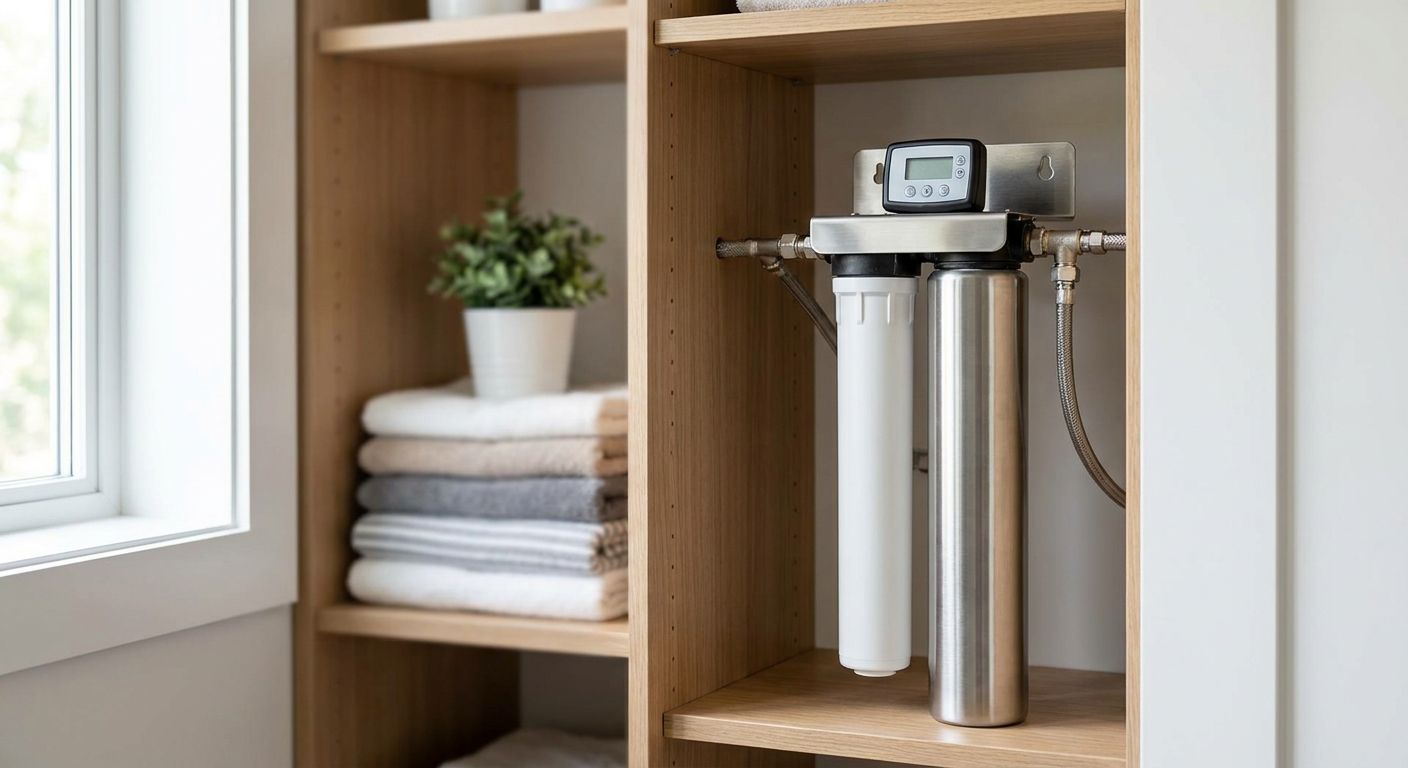
The compact all-in-one tank design is the reason this tops the list for small households. It combines filtration and TAC-based scale conditioning in a single unit sized for apartments, condos, and one-to-two-bathroom homes rather than large-house flow rates.
It handles lower GPM demand well, which is exactly the profile of a small household, and it skips the bulky twin-tank setup larger systems require. Verdict: Buy if your home has one or two bathrooms and floor space is limited.
2. SpringWell FutureSoft — the whole-house workhorse
SpringWell FutureSoft uses TAC technology across a broader flow rate range, making it the pick if you want stronger, more consistent scale prevention without jumping to a full-size four-bathroom system. It's built for homes that might grow slightly — a small household today that expects a kitchen remodel or an added bathroom later.
The tradeoff is a bigger footprint than the Aquios unit, so it needs more utility space. Verdict: Buy if you want headroom for future household growth and have the space for a slightly larger tank.
3. Aquasana Rhino with salt-free softener add-on — the filtration-plus pick
Aquasana Rhino pairs whole-house filtration with an optional salt-free softening stage, which matters if your household cares as much about chlorine and sediment as it does about scale. This is the system for households where water taste and chemical reduction are equal priorities to scale prevention.
It's a two-part investment — filtration tank plus softener add-on — so total cost runs higher than a standalone TAC unit. Verdict: Buy if filtration quality matters as much as scale control to your household.
4. Pelican NaturSoft — the mid-range compromise
Pelican NaturSoft sits between compact and full-size units, using TAC media in a moderate footprint. It's a reasonable fit for a small household that isn't sure yet whether it'll outgrow a compact unit, but it doesn't clearly win on space or on capacity the way the top two picks do.
Verdict: Hold — get a hardness test first; if your GPG reading is under 10, a cheaper compact unit does the same job.
5. iSpring ED2000 — the budget filter-first pick
iSpring ED2000 leans more toward filtration than dedicated scale conditioning, which makes it a weaker fit if scale buildup on fixtures and water heaters is your main complaint. It's a fine choice if your priority is chlorine and sediment reduction and scale prevention is secondary.
Verdict: Wait unless filtration, not softening, is your primary problem — a mismatched priority here means paying for a category term without the specific fix you need.
Comparison Table
| System | Best For | Footprint | Verdict |
|---|---|---|---|
| Aquios Full House Water Softener and Filter | 1-2 bath homes, apartments | Compact, single tank | Buy |
| SpringWell FutureSoft | Homes expecting growth | Medium, single tank | Buy |
| Aquasana Rhino + softener add-on | Filtration + scale control | Medium-large, two-part | Buy |
| Pelican NaturSoft | Undecided hardness level | Medium | Hold |
| iSpring ED2000 | Filtration-first households | Compact | Wait |
Where To Buy
- Buy direct from the manufacturer's site or an authorized dealer — third-party marketplace listings for these systems carry a higher rate of counterfeit filter cartridges.
- Confirm NSF/ANSI 42 certification on the listing page before ordering; if it's not stated, it's not certified for the scale-reduction claim being marketed.
- Get the unit installed by a licensed plumber rather than doing a DIY tie-in on your main line — a bad bypass valve installation on a whole-house system is a common failure point that voids warranties.
Not sure which softener fits your home?
Get a hardness test and installation quote from a licensed Sacramento plumber.
FAQ
What's the best salt free water softener for a small house in 2026?
The Aquios Full House Water Softener and Filter is the best salt free water softener for small households in 2026 because of its compact single-tank design built for one-to-two-bathroom homes. Larger households or those expecting to add bathrooms should look at SpringWell FutureSoft instead.
Is a salt-free water softener better than a salt-based one?
Neither is strictly better — a salt-based softener actually removes hardness minerals, while a salt-free TAC system only prevents them from forming scale. Choose salt-free if you want to avoid added sodium and don't mind water that's still technically hard.
How much does a salt-free water softener cost installed?
Installed cost for a compact salt-free system typically runs $1,000 to $3,000 in 2026, depending on home size and whether it's paired with a filtration add-on. Whole-house units with higher flow rates land at the top of that range.
Do salt-free water softeners actually work?
TAC-based salt-free systems are effective at preventing scale buildup on pipes and fixtures, but they don't remove hardness minerals from the water itself. If your goal is scale prevention rather than true water softening, they work as advertised.
What size salt-free softener do I need for a small household?
A one-to-two-bathroom home generally needs a compact unit rated for lower GPM flow rates, not a full-size whole-house system built for four-plus bathrooms. Oversizing wastes money without improving scale prevention.
Is NSF/ANSI 42 certification necessary for a salt-free softener?
Yes — NSF/ANSI 42 is the certification standard that verifies scale-reduction and aesthetic-effect claims for these systems. A unit without this certification hasn't been independently verified for the claims on its packaging.
Can I install a salt-free water softener myself?
Some compact units support DIY installation, but tying into a home's main water line without a proper bypass valve is a common failure point. A licensed plumber installation typically preserves the manufacturer warranty and avoids leak risk.
Do salt-free softeners need maintenance?
TAC media in salt-free systems generally needs replacement every few years rather than constant salt refills, which is lower maintenance than a salt-based system. Filtration add-ons like the Aquasana Rhino require separate cartridge changes on their own schedule.
One Last Thing
The detail most homeowners miss: a salt-free water softener will not show up as "softer" water on a standard hardness test strip, because the minerals are still present — they're just crystallized so they can't bond to surfaces. If you're expecting the slippery feel of softened water like a salt-based system produces, a TAC unit won't deliver that, and that mismatch is the single biggest source of buyer regret in this category.