Hard water doesn't just leave spots on your glasses — it shortens the life of every water heater in Sacramento by coating heating elements, tanks, and heat exchangers in mineral scale until they fail early. This guide ranks the water heater types that actually hold up against hard water in 2026, and tells you which ones to skip.
- Self-cleaning tank models like the A.O. Smith Signature Premier resist sediment buildup better than standard tanks in 2026 — Buy for most Sacramento homes.
- Condensing tankless units with scale-resistant heat exchangers, like the Navien NPE-2, are the best water heater for hard water if you're also replacing an aging unit.
- Basic builder-grade tanks without a self-cleaning dip tube fail fastest above 7 grains per gallon of hardness — Skip in hard water zip codes.
- Pairing any water heater with a water softener cuts scale buildup dramatically and extends service life regardless of brand.
Why hard water matters for your water heater choice
The U.S. Geological Survey classifies water above 7 grains per gallon (gpg) as hard, and above 10.5 gpg as very hard. Many homes across the Sacramento area test in the moderately hard to hard range, which means dissolved calcium and magnesium are constantly settling out inside your tank or tankless heat exchanger every time water heats up.
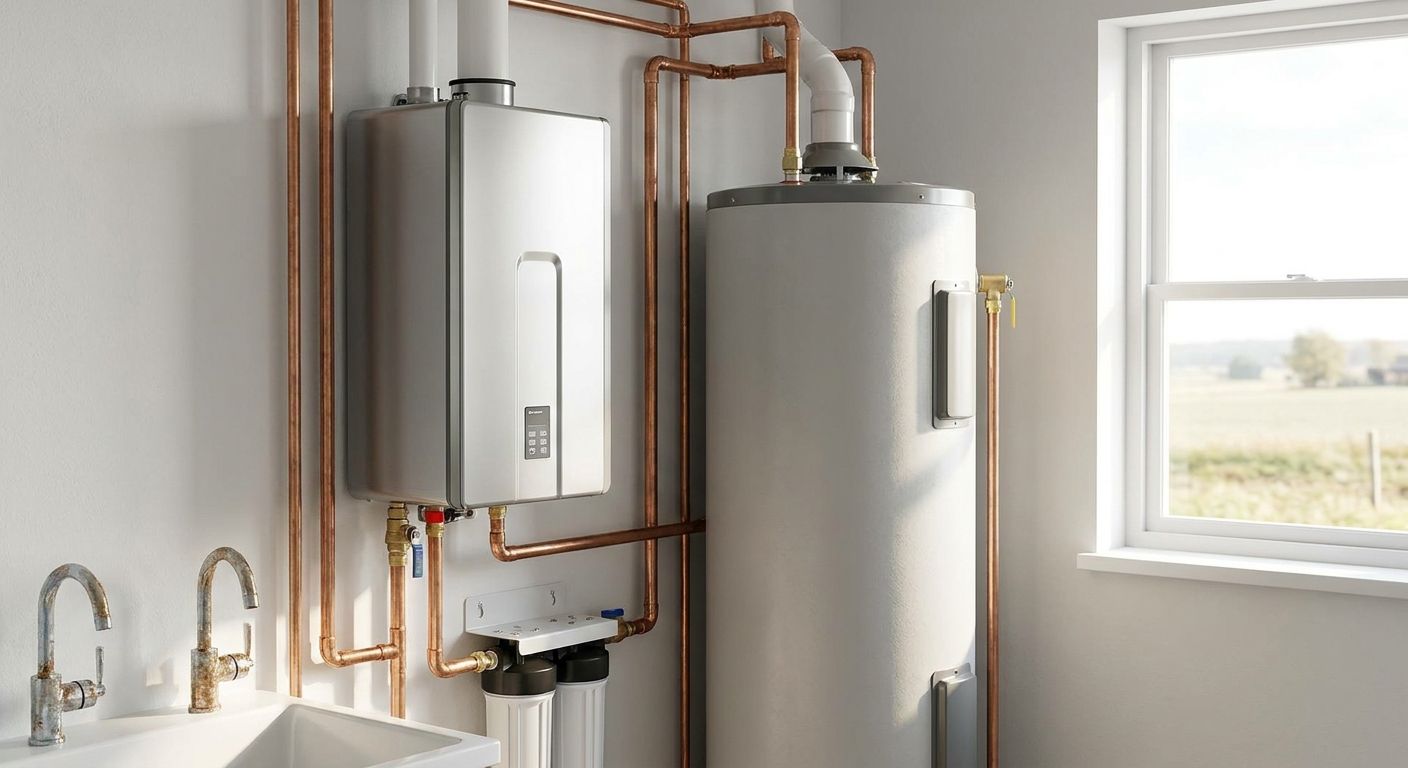
In a tank unit, that mineral load sinks to the bottom and insulates the burner or element from the water above it, forcing the unit to run longer to reach temperature. In a tankless unit, scale narrows the internal passages of the heat exchanger, which cuts flow rate and can trigger error codes years before the unit should fail. Neither type is immune — the difference is how the design handles it.
The Flores Precision Plumbing team sees the same failure pattern on service calls across Sacramento: units rated for 8-12 years dying at year 5 or 6 because nobody accounted for water hardness when the unit was picked.
How these picks were ranked
Each water heater on this list was evaluated against three factors that matter specifically in hard water: whether the tank or heat exchanger design includes scale-resistant engineering, how often the manufacturer recommends descaling or flushing, and how the unit performs once hardness climbs past 7 gpg based on field patterns seen across residential installs. Standard builder-grade units without any scale mitigation were scored down regardless of price, because they cost more in service calls over a 10-year span than the upfront savings are worth.
This list favors real-world durability over spec-sheet efficiency numbers, since a water heater that dies at year 6 was never efficient to begin with.
The best water heaters for hard water in 2026
1. A.O. Smith Signature Premier — the safe pick for most homes
This tank model uses a self-cleaning dip tube that stirs sediment on every heating cycle instead of letting it settle and bake onto the tank floor. That single design detail is the difference between a tank that needs flushing twice a year and one that can stretch closer to once. For a straightforward tank replacement in a Sacramento home with moderately hard water, this is the least risky call. Verdict: Buy.
2. Rheem Professional Prestige Series — the value pick
Rheem's Prestige line pairs a self-cleaning tank design with app-based monitoring, so you get an alert before a leak or a heating fault turns into a flood. It doesn't out-engineer the A.O. Smith on scale resistance, but it typically lands at a lower install cost for comparable capacity. If budget is the deciding factor and hardness isn't extreme in your neighborhood, this is a reasonable trade. Verdict: Buy.
3. Navien NPE-2 — the tankless pick for whole-house demand
The NPE-2 is a condensing tankless unit built with a scale-resistant heat exchanger and a wider internal passage than older tankless designs, which matters because narrow passages are exactly where hard water does the most damage. It's the strongest option if you're already choosing between tankless and traditional water heaters and want endless hot water without babying a tank. It still needs regular descaling in hard water zones — skip the maintenance and you'll shorten its life fast. Verdict: Buy, with a flushing schedule.
4. Rinnai Sensei SE+ — the smart pick
Rinnai's Sensei line includes built-in scale detection that flags when the heat exchanger needs service before performance drops, which takes the guesswork out of maintenance timing. It's a strong runner-up to the Navien for hard water zones and worth considering if smart diagnostics matter more to you than raw flow rate. Verdict: Consider.
5. Bradford White with oversized anode protection — the workhorse pick
Bradford White tanks are known in the trade for larger anode rods than many competitors, which helps in mineral-heavy water by giving the sacrificial metal more mass to corrode before the tank itself takes damage. It's not flashy and it doesn't have app connectivity, but plumbers who install a lot of these report fewer emergency callbacks over the first 5 years. Verdict: Consider.
6. Basic builder-grade tank, no self-cleaning feature — the one to skip
This is what's already installed in a lot of Sacramento homes built before hard water design became standard. Without a self-cleaning dip tube or any scale mitigation, sediment bakes onto the tank floor fast once hardness crosses 7 gpg, and that sediment layer is what causes the popping and rumbling noise homeowners hear right before a failure. Verdict: Skip if you're replacing a unit anyway.
“If your water tests above 10 grains per gallon, plan on descaling twice a year, not once.”
Get a hard-water-ready water heater installed
Sacramento install quotes typically turn around within days, not weeks.
Comparison table
| Water heater | Type | Hard water feature | Verdict |
|---|---|---|---|
| A.O. Smith Signature Premier | Tank | Self-cleaning dip tube | Buy |
| Rheem Professional Prestige | Tank | Self-cleaning + app monitoring | Buy |
| Navien NPE-2 | Tankless | Scale-resistant heat exchanger | Buy |
| Rinnai Sensei SE+ | Tankless | Built-in scale detection | Consider |
| Bradford White (oversized anode) | Tank | Larger sacrificial anode | Consider |
| Basic builder-grade tank | Tank | None | Skip |
Where to buy: sourcing rules for hard water areas
- Buy through a licensed installer, not a big-box counter. Warranty registration and correct sizing both depend on professional install, and an undersized unit scales faster because it runs longer per cycle.
- Ask for the hardness reading before you pick a model. A unit that's fine at 4 gpg can struggle at 9 gpg — get your water tested first, not after the unit is already in the wall.
- Pair the purchase with a softener conversation. If you're already spending on a new water heater, this is the moment to evaluate how to choose a water softener for hard water homes rather than treating scale prevention as a separate project later.
Maintenance keeps any pick on this list working
Even the best water heater for hard water needs upkeep. Tankless owners in hard water zones should flush a tankless water heater twice a year instead of the standard once-annual schedule, and tank owners should have the anode rod checked every 2-3 years regardless of brand. Skipping this step is the single biggest reason a well-chosen unit still fails early.
FAQ
What's the best water heater for hard water in 2026?
Tank models with a self-cleaning dip tube, like the A.O. Smith Signature Premier, and condensing tankless units with scale-resistant heat exchangers, like the Navien NPE-2, hold up best against hard water in 2026. Standard builder-grade tanks without scale mitigation fail fastest.
Is tankless better than a tank for hard water?
Neither type is immune to hard water, but tankless units need more frequent descaling because scale narrows the internal heat exchanger passages faster than it affects a tank. A tank with a self-cleaning dip tube can be lower maintenance in hard water than a tankless unit without scale protection.
How often should you flush a water heater in hard water areas?
Tankless units in hard water areas should be flushed twice a year instead of once annually. Tank units benefit from an anode rod check every 2-3 years and a sediment flush at least once a year.
Does a water softener extend water heater life?
Yes, pairing a water softener with any water heater significantly reduces the mineral scale that causes early failure. It's worth evaluating alongside a water heater replacement rather than as a separate later project.
What grains per gallon counts as hard water?
The U.S. Geological Survey classifies water above 7 grains per gallon (gpg) as hard, and above 10.5 gpg as very hard. Many homes in the Sacramento area test in the moderately hard to hard range.
Can hard water void a water heater warranty?
Manufacturers can deny warranty claims tied to scale damage if the required maintenance schedule wasn't followed, which is why descaling records matter in hard water zones. Keeping a service log protects the warranty even if a claim is never needed.
How long do water heaters last in hard water areas?
A unit rated for 8-12 years can fail by year 5 or 6 in hard water if it lacks scale protection and isn't maintained on schedule. Units with self-cleaning tanks or scale-resistant heat exchangers, maintained properly, are more likely to reach their full rated lifespan.
Should I size up my water heater for hard water?
Sizing should match household demand, not hardness, but an undersized unit runs longer per cycle and scales faster as a result. Correct sizing at install is one of the simplest ways to slow scale buildup over time.
One last thing
The detail most homeowners miss: the noise a scaling tank makes — a popping or rumbling sound during heating — shows up months before the unit actually fails, and it's the cheapest possible warning sign to act on. Catching it early is the difference between a scheduled replacement and an emergency one.