Your water heater doesn't send a text message when it's dying — it leaves clues. Rust-colored water, a tank that's rumbling like a coffee maker, or a puddle on the garage floor all point to the same question: repair it or replace it. This guide walks through the checks a plumber runs before making that call, so you can make it yourself first.
- A tank water heater past 10-12 years old with rust-colored hot water needs replacement, not another repair.
- Popping or rumbling noises mean sediment buildup that shortens tank life and raises energy bills.
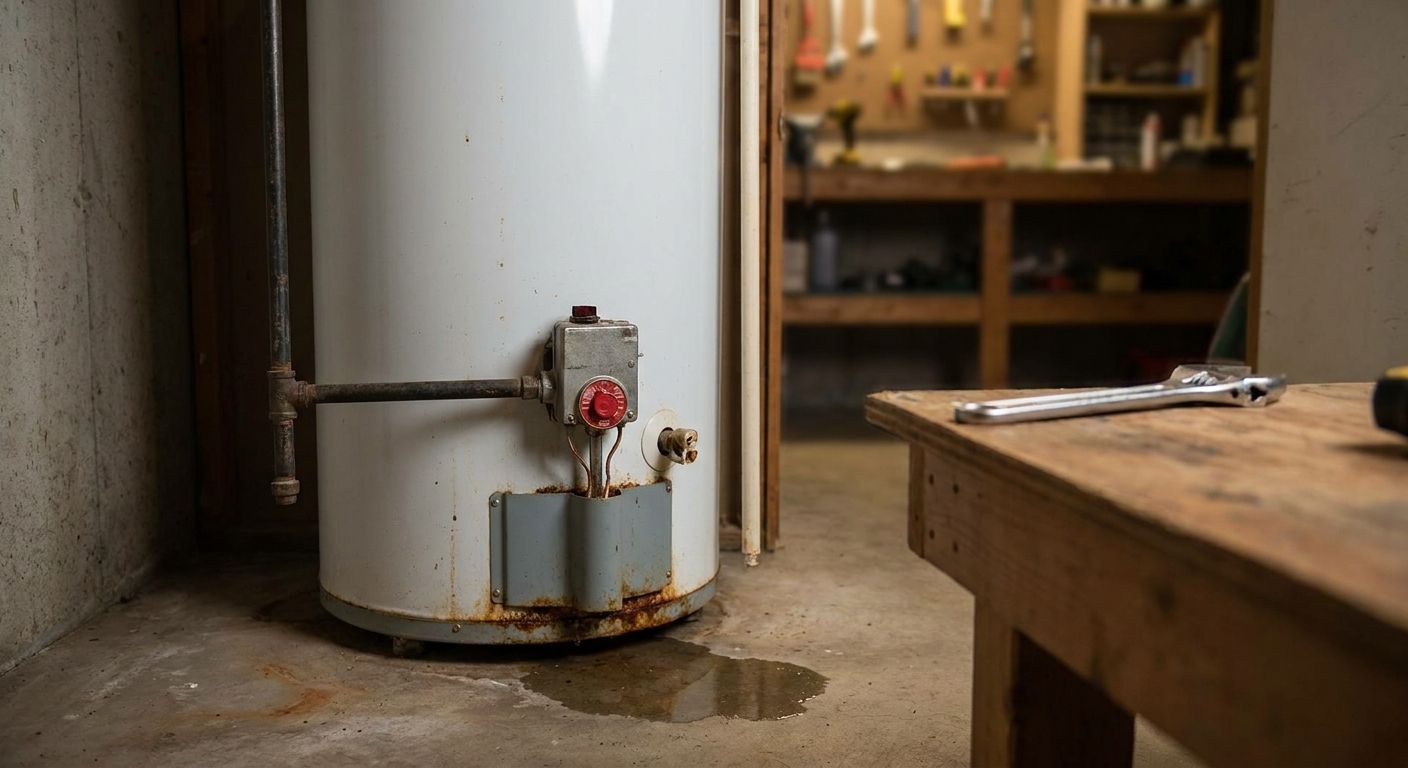
- Puddles at the base of the tank signal a cracked inner lining — there's no fixing that, only replacing it.
- Sacramento's hard water accelerates sediment buildup, so local units often show signs of wear before the national 8-12 year average.
Why this matters
A failing water heater rarely quits without warning — it degrades for months before it floods a garage or a closet. Catching the signs early means you choose the replacement on your schedule, not during an emergency call at 9 p.m. on a Sunday. In Sacramento, hard water mineral content speeds up sediment buildup inside the tank, which means local units often show wear before hitting the national average lifespan. Flores Precision Plumbing inspects hundreds of these systems a year, and the same handful of warning signs show up over and over.
Waiting past those signs doesn't save money — it usually costs more once a tank ruptures and takes drywall or flooring with it.
What you'll need
Before you inspect your water heater, gather these:
- A flashlight to check the base of the tank and the drain valve
- A notepad or phone to log the age (check the serial number on the manufacturer's label) and any noises or leaks
- A bucket, in case you need to check the temperature-pressure relief valve
- 15-20 minutes of uninterrupted time near the unit
- If you're already leaning toward replacement, a rough sense of your household's hot water demand — this determines whether a tankless water heater installation in Sacramento makes sense versus another tank
The steps
1. Check the age on the serial number
Find the manufacturer's label near the top of the tank — the serial number's first four digits are usually the manufacture month and year. A tank water heater past 10-12 years old is in its final stretch even if it looks fine today, since internal corrosion isn't visible from outside. Anything over 12 years is a replacement candidate regardless of other symptoms. Common mistake: people check the installation date on a sticker added by a previous plumber, which can be years newer than the actual manufacture date.
2. Run the hot water and check the color
Let hot water run into a white bucket or sink for 30 seconds. Rust-colored or muddy water means the tank's interior lining has broken down and the steel shell underneath is corroding. This is different from sediment discoloration, which usually clears after a minute of running water. If the color persists past a minute, that's active corrosion, not a fluke — schedule a replacement conversation. Common mistake: assuming discolored water is a city supply issue without testing both hot and cold taps for comparison.
3. Listen for popping, rumbling, or cracking
Stand near the tank while it's heating and listen. A popping or rumbling sound comes from sediment hardening at the bottom of the tank and trapping water beneath it, which then boils and pops through the layer. This buildup makes the unit work harder, raises energy use, and stresses the tank walls over time. Tankless units make a different noise entirely — a whining or knocking sound usually means mineral scale in the heat exchanger, which is fixable by descaling rather than replacing. Common mistake: ignoring the noise because the water still gets hot — sediment buildup gets worse, not better, on its own.
4. Inspect the base and connections for moisture
Run your flashlight around the base of the tank, the drain valve, and the top water connections. Moisture at the base of the tank itself, not the fittings, means the internal tank has cracked and is weeping through the steel — this cannot be repaired. Moisture only at a fitting or valve can sometimes be tightened or replaced without swapping the whole unit. Common mistake: tightening a leaking base fitting and assuming the problem is solved when it's actually the tank shell failing slowly.
5. Test the temperature-pressure relief valve
Lift the lever on the T&P valve briefly (with a bucket underneath) and let it snap back. It should release a burst of water and then stop. A valve that won't stop dripping, or one that does nothing at all, is a safety issue on its own, separate from the tank's age. Common mistake: skipping this test because the tank is heating fine — the T&P valve is a pressure safety device, not a performance indicator.
6. Check recovery time and hot water volume
Time how long it takes for hot water to run out during a normal shower or how long it takes the tank to reheat afterward. A noticeable drop in either compared to a year ago points to sediment cutting usable tank volume or a failing heating element. If your household has grown or your hot water needs have changed, this is also the moment to compare tankless versus traditional water heaters rather than replacing like-for-like.
7. Check for hard water buildup risk
Sacramento's water supply runs moderately hard, and mineral deposits build up faster in areas with hard water than the national average assumes. If you've never had a water softener for hard water installed, sediment and scale are likely accumulating faster than the manufacturer's rated lifespan expects. This step doesn't tell you whether to replace today, but it tells you why your unit might be aging faster than the 8-12 year average.
Not sure if it's a repair or a replacement?
Get a straight answer on your water heater's condition before it fails.
Troubleshooting
- Water heats but runs out fast. Sediment has reduced usable tank volume — flushing the tank sometimes restores capacity, but if the unit is past 10 years, flushing is a temporary fix, not a solution.
- Pilot light won't stay lit (gas units). Usually a thermocouple issue, cheap to fix, and not a sign the tank itself needs replacing.
- Water smells like rotten eggs. A reaction between the anode rod and bacteria in the water — replacing the anode rod often resolves it without replacing the tank.
- Tankless unit throws an error code and shuts off. Usually scale buildup in the heat exchanger — see the flushing steps below before assuming the unit has failed.
- Water pressure drops only on hot water taps. Sediment is restricting flow inside the tank or in the hot water line itself, not necessarily a sign of full tank failure.
- Inconsistent temperature, hot then cold then hot. A failing heating element or a dip tube breaking down inside the tank — both are repairable on units under 8 years old.
Tools and resources
- Flashlight and a white bucket for the color and T&P valve checks above
- The manufacturer's label for age verification
- If you run a tankless system, review how to flush a tankless water heater — descaling on a 12-18 month schedule extends the 15-20 year expected lifespan
- A notepad to track noises, discoloration, or leaks over a two-week period rather than relying on a single observation
What to do next
If your tank is past 10 years old and showing two or more of these signs, stop treating it as a repair project. Get a professional inspection before it fails on its own schedule instead of yours — a controlled replacement costs less in time and cleanup than an emergency one.
FAQ
What are the main signs a water heater needs replacement?
Rust-colored hot water, popping or rumbling noises, moisture pooling at the tank's base, and an age past 10-12 years are the four clearest signs a water heater needs replacement. Any one of these on its own is worth investigating; two or more together usually means replacement beats repair.
How long do water heaters last in 2026?
Tank water heaters last 8-12 years on average in 2026, while tankless units last 15-20 years. Hard water areas, including much of Sacramento, tend to shorten those ranges due to faster sediment and scale buildup.
Is it cheaper to repair or replace a water heater?
Repair is usually cheaper for units under 8 years old with a single isolated issue, like a thermocouple or heating element. Replacement makes more financial sense once the tank itself shows corrosion, leaks at the base, or is past 10 years old, since repeated repairs on an aging tank add up without extending its life.
Can a water softener extend a water heater's life?
Yes — reducing mineral content in the water slows sediment and scale buildup inside the tank or heat exchanger. In hard water areas this can meaningfully extend a unit toward the upper end of its expected 8-12 or 15-20 year lifespan.
Should I switch to a tankless water heater when replacing my tank?
It depends on household hot water demand and existing gas or electrical capacity, not just on the fact that the old tank failed. Larger households with simultaneous hot water use often benefit from tankless units rated for higher flow rates.
What noise does a failing water heater make?
A popping or rumbling sound in a tank unit points to hardened sediment at the bottom trapping and boiling water. A whining or knocking sound in a tankless unit usually points to mineral scale in the heat exchanger, which is often fixable through descaling.
Is discolored hot water always a sign of a dying water heater?
Not always — sediment can discolor water temporarily and usually clears within a minute of running the tap. Persistent rust-colored water beyond that points to internal tank corrosion, which is not repairable.
How often should a tankless water heater be flushed?
Every 12 to 18 months in most homes, more often in hard water areas. Skipping this maintenance shortens the unit's expected 15-20 year lifespan by letting scale build up on the heat exchanger.
One last thing
The single most overlooked check is the temperature-pressure relief valve — most homeowners never test it until something goes wrong, but it's a 30-second check that catches a genuine safety issue separate from the tank's age. Test it the same day you check the manufacturer's date.