If your well water leaves rust-colored rings in the toilet bowl and orange streaks on the shower tile, a standard water softener won't fix it alone -- you need a system sized for iron, not just hardness.
- A fine-mesh water softener for iron in well water only handles ferrous iron below 3-5 ppm on its own -- Buy it at that range.
- Above 5 ppm iron or any rust-colored (ferric) staining, pair the softener with an oxidizing pre-filter -- Consider it.
- Standard 32,000-grain softeners rated for hardness alone foul on ferric iron within weeks -- Skip them for well water homes.
- Test your well for iron, manganese and hardness before sizing anything in 2026; guessing wastes the install budget.
Why this matters
Iron doesn't just stain -- it clogs. Standard softener resin beads are built to swap calcium and magnesium ions for sodium, and iron particles gum up that resin faster than hardness minerals ever will. The EPA's secondary drinking water standard sets iron at 0.3 mg/L (ppm) before staining becomes visible, and most Sacramento-area wells that test high run well past that number. Manganese, iron's usual travel partner, has its own secondary standard of 0.05 mg/L and causes the same black staining problem if it's ignored during sizing.
Get the sizing wrong and you'll replace resin or a whole unit within a year instead of running it for a decade.
Who this is for
This guide is for homeowners on private well water -- not municipal service -- who are seeing rust stains on fixtures, orange or brown laundry spotting, or a metallic taste from the tap. If you're on a Sacramento municipal connection with garden-variety hardness and no staining, a standard softener setup covers you; the sizing questions here only matter once iron and manganese enter the picture. Flores Precision Plumbing handles both scenarios, but the equipment list and maintenance schedule diverge hard once iron is in the water.
What to look for in a water softener for iron in well water
Iron capacity rating, not just grain capacity
Every softener lists a grain capacity -- 32,000, 48,000, or 64,000 grains is standard for residential units -- but that number assumes hardness minerals only. Manufacturers derate capacity roughly 3-5 grains per gallon for every 1 ppm of iron present, so a 48,000-grain unit rated for a 10 gpg household can lose a third of its working capacity on a well testing at 4 ppm iron.
Ferrous vs. ferric iron identification
Clear water that turns rust-colored after sitting is ferrous (dissolved) iron -- a softener alone can often manage this below 3-5 ppm. Water that comes out of the tap already rust-colored is ferric (oxidized) iron, and it will not dissolve back into resin exchange the way ferrous iron does. That distinction decides whether you need whole-house water filtration for well water homes ahead of the softener or can run the softener solo.
Resin bead type
Standard 8% cross-linked resin works fine for hardness-only water. Iron-heavy well water calls for fine-mesh, 10% cross-linked resin -- it exchanges ions more efficiently and resists the fouling that shortens the life of standard beads when iron particles coat them.
Backwash frequency and iron-out cleaner compatibility
A softener fighting iron needs to backwash more often than a hardness-only unit, and it needs a resin cleaner rated for iron removal, not just a generic softener salt additive. Skip a system that can't run scheduled iron-out cycles and you'll see capacity drop off within the first six months.
Pre-filtration for high iron and manganese
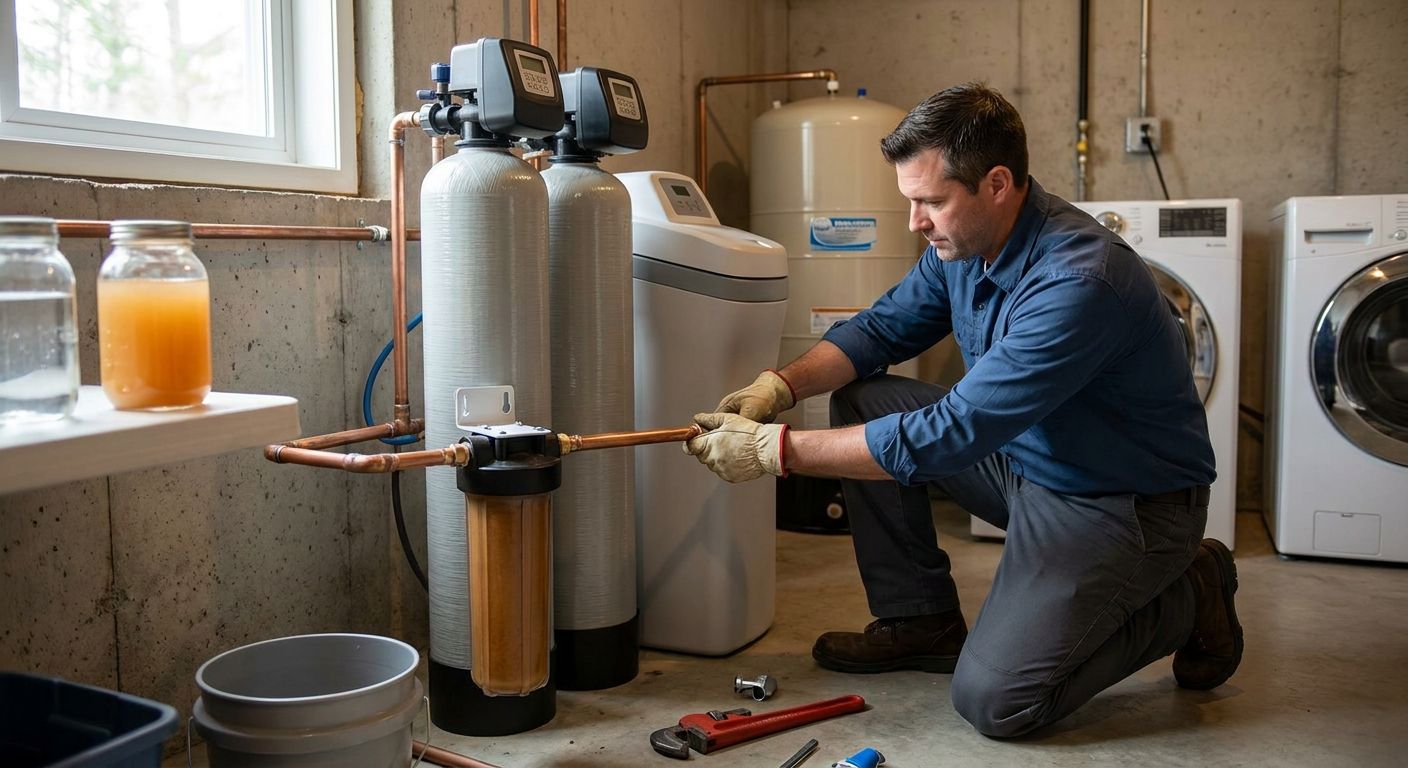
Once iron tests above 5 ppm, or manganese shows up alongside it, an oxidizing filter ahead of the softener (air injection or chlorine-based) converts dissolved iron to a filterable solid before it ever reaches the resin bed. This is the single biggest factor in whether a softener lasts 10 years or 18 months on well water.
A current water test, not an old one
Well water chemistry shifts with the water table and season. Size the equipment off a test run in 2026, not a report from three or five years ago -- iron and manganese levels on the same well can swing by a full ppm or more between wet and dry seasons.
Top picks for iron-heavy well water
The safe pick: fine-mesh softener alone. For wells testing under 3-5 ppm ferrous iron with no manganese, a fine-mesh resin softener sized with iron-capacity derating handles the job without added equipment. One spec that matters: confirm the unit's rated capacity after the 3-5 grains-per-gallon-per-ppm-iron adjustment, not the sticker number. Get the sizing dialed in through how to choose a water softener for hard water homes before committing. Verdict: Buy if your test comes back under that ferrous threshold.
The wildcard: air injection oxidizer plus softener. For ferric iron or anything testing 5-10 ppm, an air injection oxidizing filter installed ahead of the softener converts dissolved iron to solid form and backwashes it out before resin ever sees it. It costs more up front than a softener alone but prevents the resin fouling that forces early replacement. Verdict: Consider it standard practice, not an upgrade, once iron crosses 5 ppm.
The upgrade pick: whole-house filtration and softener combo. Wells running high iron alongside manganese, sulfur odor, or sediment need a combined filtration and softening setup rather than stacked standalone units. Verdict: Buy if your test shows two or more contaminants above secondary EPA standards -- treating them separately usually costs more over time than one integrated system.
“If your well tests above 5 ppm iron, a softener alone will not fix it -- you need an oxidizing pre-filter ahead of the resin.”
What to avoid
- Hardness-only softeners marketed as "whole-home" systems. They look identical to iron-rated units on a spec sheet but carry standard 8% resin that fouls fast on ferric iron.
- Salt-free "conditioners" for iron control. These units address scale, not iron removal, and won't touch staining problems on a well running above 0.3 ppm iron.
- Undersized units bought off hardness numbers alone. A 32,000-grain softener sized only for a 12 gpg household will run through regeneration cycles constantly once 3+ ppm iron is added to the math.
Verdict comparison
| Setup | Handles ferrous iron | Handles ferric iron | Resin type | Verdict |
|---|---|---|---|---|
| Standard softener (8% resin) | Under 2 ppm only | No | Standard cross-link | Skip for well water |
| Fine-mesh softener alone | Up to 3-5 ppm | Limited | 10% cross-link | Buy under 5 ppm |
| Air injection oxidizer + softener | Yes | Yes, up to ~10 ppm | 10% cross-link | Buy above 5 ppm |
| Whole-house filtration + softener | Yes | Yes, plus manganese/sulfur | 10% cross-link | Buy for multi-contaminant wells |
Get your well water tested and sized right
Iron, manganese and hardness readings decide the setup -- get a proper read before buying equipment.
FAQ
Does a water softener remove iron from well water?
A water softener removes dissolved (ferrous) iron up to roughly 3-5 ppm using fine-mesh resin. Above that level or with rust-colored (ferric) iron, it needs an oxidizing pre-filter ahead of the resin bed to work.
How much iron is too much for a softener alone?
Above 5 ppm ferrous iron, or any visible ferric staining, a softener alone fouls within months. Pairing it with an air injection oxidizer or moving to whole-house filtration is the standard fix in 2026.
Is a water softener for iron in well water different from a regular softener?
Yes -- iron-rated softeners use 10% cross-linked fine-mesh resin instead of standard 8% resin, and they're sized with an iron-capacity derating, not just a grain-per-gallon hardness number.
What's the difference between ferrous and ferric iron?
Ferrous iron is dissolved and clear until it hits air, then turns rust-colored. Ferric iron is already oxidized and comes out of the tap rust-colored, and it resists standard resin exchange.
Can a whole-house filter replace a water softener on well water?
A whole-house filter removes sediment, iron, and manganese but doesn't address hardness minerals the way softener resin does. Wells with both iron and hardness problems generally need both systems working together.
How often does an iron-fouled softener need maintenance?
Softeners treating iron-heavy well water need iron-out resin cleaner cycles more frequently than hardness-only units, often monthly instead of quarterly, depending on the ppm level.
Does manganese need separate treatment from iron?
Manganese often travels with iron in well water and has its own EPA secondary standard of 0.05 mg/L. Most combined filtration systems built for iron also address manganese in the same pass.
One last thing
Iron bacteria -- the reddish-brown slime sometimes found in toilet tanks or well casings -- isn't fixed by any softener or filter. It needs shock chlorination of the well itself before any equipment is installed, otherwise the bacteria colony just re-contaminates a brand-new system within weeks.